
According to the NHS, most adults need between 7 and 9 hours of sleep per night. The American Academy of Sleep Medicine (AASM) recommends at least 7 hours nightly for adults aged 18 to 60. Children and teenagers require significantly more. According to the CDC, school age children need 9 to 12 hours, while teenagers require 8 to 10 hours daily.
How many hours of sleep do adults need?
According to the UK National Health Service (NHS), most healthy adults require between 7 and 9 hours of sleep each night. Exact individual requirements vary depending on overall health, daily physical activity, and genetics.
The American Academy of Sleep Medicine (AASM) and Sleep Research Society joint consensus statement recommends that adults aged 18 to 60 sleep 7 or more hours per night on a regular basis. Dr. Nathaniel Watson, who chaired the consensus panel, notes that sleeping 6 hours or less per night is insufficient to maintain optimal health and safety in adults. The US National Heart, Lung, and Blood Institute (NHLBI) similarly warns that sleeping less than 7 hours per night increases risks of cardiovascular disease, obesity, and diabetes.
Recommended sleep hours by age
The US Centers for Disease Control and Prevention (CDC) provides recommended daily sleep durations across the lifespan:
- 0-3 months14-17 hours
- 4-12 months12-16 hours
- 1-2 years11-14 hours
- 3-5 years10-13 hours
- 6-12 years9-12 hours
- 13-17 years8-10 hours
- 18-60 years7+ hours
- 61-64 years7-9 hours
- 65+ years7-8 hours
Source: CDC
Recommended amounts for ages 4 months through 5 years include daytime naps as well as nighttime sleep. For adults aged 18 to 60, public health bodies recommend at least 7 hours nightly as a protective baseline.
The CDC adopts pediatric guidelines endorsed by the AASM and AAP. Infant guidelines for the first 3 months and older adult ranges stem from the National Sleep Foundation. The NHS offers a broad recommendation of 9 to 13 hours for children and 12 to 17 hours for infants. For month by month details on infant sleep, read our guide on baby sleep how many hours.
Timing and consistency of sleep
For adults, the target remains 7 to 9 hours nightly. Timing and regularity matter just as much as cumulative duration. The AASM highlights that healthy sleep requires appropriate timing, daily consistency, and good quality. The CDC recommends sleeping and waking at the same time each day. The NHLBI advises keeping weekend sleep schedules within one hour of weekday routines.
To set up an effective schedule, explore our guide on sleep how to improve.
Signs that you are getting enough sleep
In addition to counting hours, observe how you feel during waking hours. According to Every Mind Matters from the NHS, when you obtain adequate sleep:
- You wake up feeling refreshed
- You have steady energy throughout the day
- You can concentrate on work and routine tasks
If you struggle to get out of bed, feel persistently exhausted or irritable, or experience midday brain fog, your sleep duration or quality may be inadequate. The CDC notes that feeling unrefreshed despite spending enough hours in bed points to fragmented, poor quality sleep.
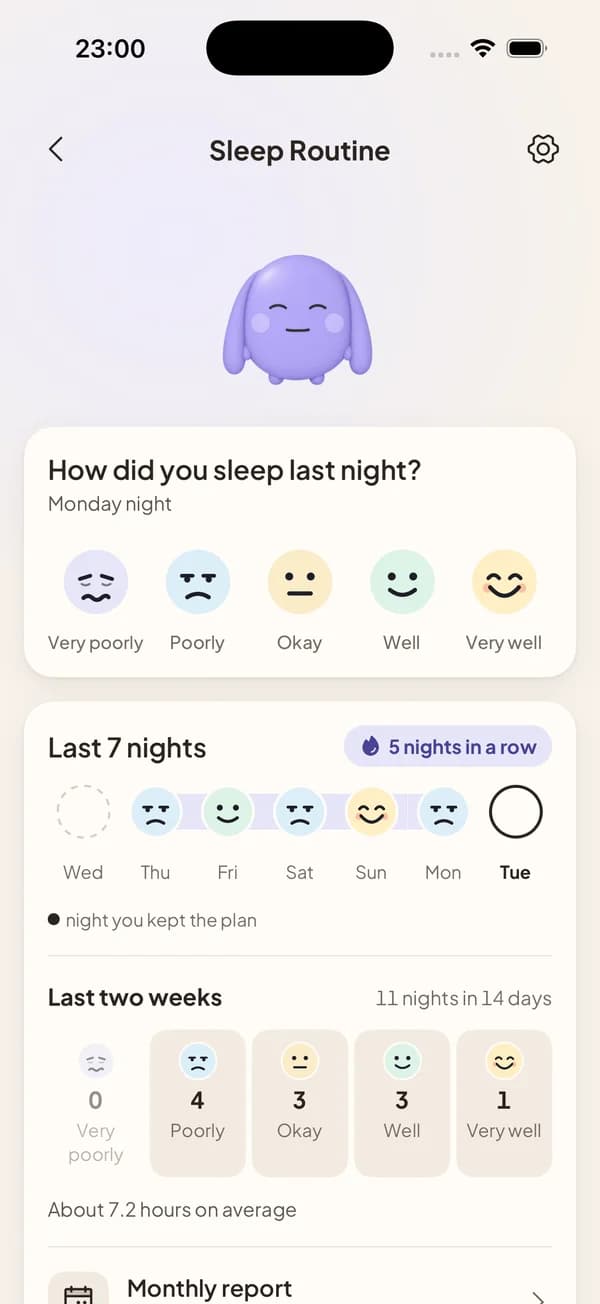
Sleep tracker
Rate last night each morning, keep a bedtime plan and see your last two weeks.
 Coming soonAndroid
 Scan with your phone camera to open the App Store.
Is sleeping more than 9 hours harmful?
According to the NHLBI, sleeping longer than 9 hours is not necessarily harmful in itself. It can be beneficial for young adults, individuals recovering from sleep debt, or those recovering from illness. The AASM consensus panel did not place a rigid upper limit for sleep, noting that extended sleep can be appropriate during recovery. Dr. Watson observes that habitually sleeping unusually long hours may be a symptom of an underlying medical condition rather than a cause. If you consistently sleep long hours and remain fatigued, discuss this with your physician.
Sleep
Rate last night each morning, keep a bedtime plan and see your last two weeks.
Your journal, mood, cycle and tracker records, including saved step counts, are stored on your device. When account backup is available and you are signed in, the app also sends an encrypted copy to our servers to restore and merge your records.
When to seek medical advice
The NHLBI advises that anyone concerned about sleeping too much or too little should consult a doctor. The AASM recommends clinical evaluation if you are dissatisfied with your sleep, experience chronic insomnia, or have persistent daytime sleepiness. The NHS recommends consulting a physician if:
- Modifying sleep habits has not resolved the problem
- You have struggled with sleep for months
- Lack of sleep impairs your ability to cope with daily life
Never drive when drowsy. If distress feels unmanageable, seek immediate emergency help. In the US call 911; in the UK call 999; in Europe call 112.
Frequently asked questions
Why do I feel constantly sleepy during the day?
Persistent daytime sleepiness usually signals insufficient sleep quantity or poor sleep quality from disruptions like sleep apnea. If daytime drowsiness persists despite spending 7 or more hours in bed, consult a healthcare provider.
What are the consequences of ongoing sleep deprivation?
According to MedlinePlus, chronic sleep deprivation leads to reduced concentration, mood disturbances, weakened immunity, and elevated risks of cardiovascular disease and accidents. For recovery strategies, read insomnia what helps.
Sources
- NHS: Insomnia
- NHS Every Mind Matters: Sleep problems
- CDC: About sleep
- NHLBI: How much sleep is enough?
- NHLBI: Healthy sleep habits
- AASM: Seven or more hours of sleep per night, a health necessity for adults
- AASM: Consumer sleep technology is no substitute for medical evaluation
- MedlinePlus: Insomnia
Sleep tracker
Rate last night each morning, keep a bedtime plan and see your last two weeks.
Coming soonAndroidScan with your phone camera to open the App Store.