When choosing a sleep tracker app, verify where your records are stored and whether creating an account is required. Check whether wearable hardware is necessary, what data is tracked, and whether the app claims diagnostic capabilities. The American Academy of Sleep Medicine states that consumer apps and wearables cannot diagnose sleep disorders.
What is a sleep tracker?
Sleep tracking involves maintaining a structured log of your sleep habits: when you go to bed, when you wake up, and how rested you feel. In clinical practice, sleep logs are widely recognized diagnostic aids. The US Centers for Disease Control and Prevention (CDC) notes that physicians frequently ask patients to keep a sleep diary to evaluate sleep patterns. The US National Heart, Lung, and Blood Institute (NHLBI) suggests keeping a sleep diary for 1 to 2 weeks prior to a clinical appointment, recording:
- Bedtime, wake up time, and any daytime naps
- Perceived sleepiness during the day
- Times of caffeine or alcohol consumption
- Times and intensity of physical exercise
You can track your sleep in a notebook, through a mobile app, or with wearable sensors. The American Academy of Sleep Medicine (AASM) terms consumer wearables and mobile apps "consumer sleep technology." These over-the-counter tools are marketed to monitor sleep patterns, encourage healthy habits, or screen for sleep issues.
Where is your personal data stored?
An application either stores your sleep history locally on your device or uploads it to a remote cloud server. Cloud storage requires clear answers to key privacy questions:
- What company operates the servers, and in which legal jurisdiction are they hosted?
- Who has access to your logs, and is data shared with advertisers or third parties?
- Are your sleep logs permanently deleted when you close your account or uninstall the app?
These details must be clearly disclosed in the privacy policy. On the iOS App Store, review the App Privacy nutrition label before downloading.
Is an account registration mandatory?
Some applications require an email address or phone number before you can use basic features. While an account allows syncing across multiple devices, it is not strictly necessary for keeping a personal sleep diary. Mandatory accounts usually signal that your health entries are transmitted to remote servers.
Do you need a smartwatch or smart ring?
Wearable devices like fitness bands and smart rings claim to track sleep stages automatically. In an official position statement, the AASM highlighted that empirical evidence supporting the accuracy of consumer sleep trackers remains limited. Most consumer wearables are not cleared as diagnostic medical devices by regulatory authorities like the US FDA. The AASM emphasizes that wearable metrics should be interpreted in the context of a comprehensive medical assessment.
Clinical sleep evaluations rely on medical actigraphy. According to the NHLBI, clinical actigraphy involves wearing a calibrated medical motion sensor on the wrist for 3 to 14 days under physician supervision. A standard sleep diary does not require any wearable hardware.
Be wary of medical diagnostic claims
Exercise caution if an app claims to diagnose conditions like sleep apnea or chronic insomnia. Former AASM President Dr. Ilene Rosen stated that consumer sleep technologies cannot provide a clinical diagnosis of sleep disorders. The AASM notes that products claiming diagnostic or therapeutic capabilities must undergo rigorous clinical validation and obtain regulatory clearance.
Consumer sleep tools still offer genuine value by raising awareness of sleep health and encouraging regular bedtime schedules. When discussed during a medical visit, sleep diary data provides a constructive starting point for doctor-patient conversations.
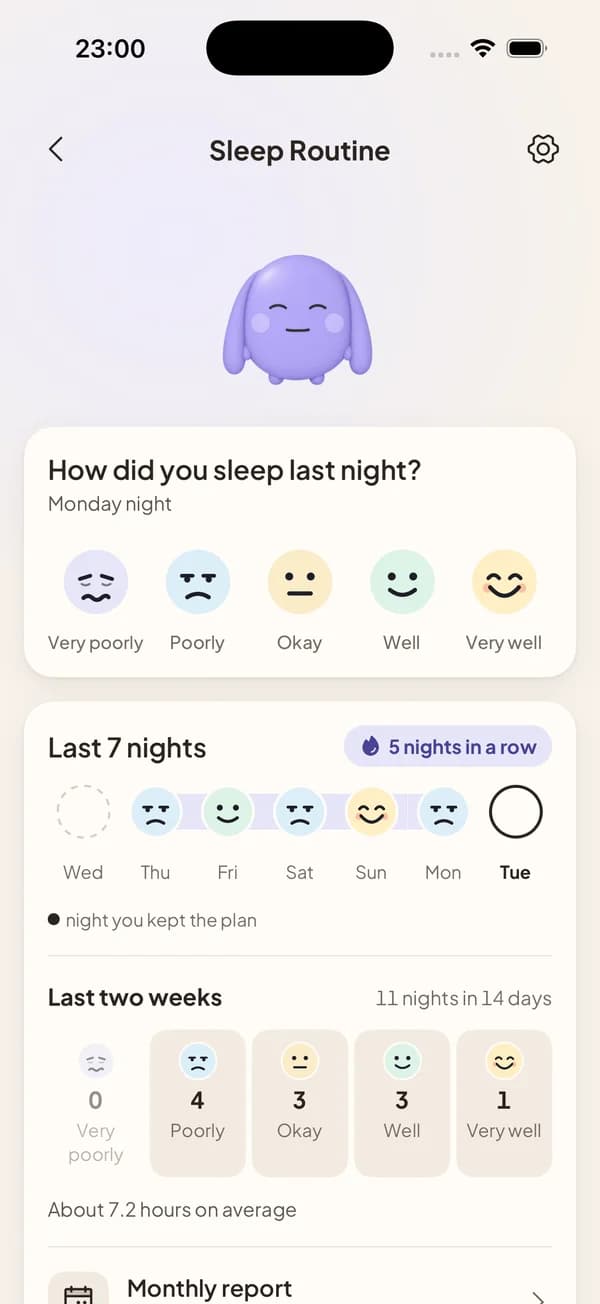
Sleep tracker
Rate last night each morning, keep a bedtime plan and see your last two weeks.
 Coming soonAndroid
 Scan with your phone camera to open the App Store.
Sleep
Rate last night each morning, keep a bedtime plan and see your last two weeks.
Your journal, mood, cycle and tracker records, including saved step counts, are stored on your device. When account backup is available and you are signed in, the app also sends an encrypted copy to our servers to restore and merge your records.
Sleep tracker evaluation checklist
Before downloading a sleep tracker, consider these five questions:
- Does your data stay privately on your device, or is it uploaded to cloud servers?
- Is an account registration mandatory for basic logging?
- Does it require purchasing external wearables or smart rings?
- What metrics does it display, and are they actionable?
- Does the app make unverified medical claims or claim to diagnose sleep disorders?
To learn more about healthy sleep duration, read sleep how many hours and our guide on sleep how to improve.
When to consult a physician
According to the AASM, regardless of what a consumer tracking app displays, consult a healthcare provider if:
- You are dissatisfied with the quality of your sleep
- You experience persistent sleep problems lasting several weeks
- You suffer from excessive daytime fatigue or sleepiness
The NHS advises seeing a doctor if adjusting bedtime habits fails to resolve sleeplessness, or if insomnia persists for months. A physician may screen for sleep apnea, especially if you snore loudly or wake up gasping. If exhaustion or emotional distress feels unmanageable, seek immediate emergency help. In the US call 911; in the UK call 999; in Europe call 112.
Frequently asked questions
Do you need a wearable device to track sleep effectively?
No. A self-reported sleep diary, as recommended by the NHLBI and CDC, provides actionable insights without wearable hardware. Consumer wearables cannot replace clinical sleep assessments.
Sleep
Rate last night each morning, keep a bedtime plan and see your last two weeks.
Your journal, mood, cycle and tracker records, including saved step counts, are stored on your device. When account backup is available and you are signed in, the app also sends an encrypted copy to our servers to restore and merge your records.
Sources
- AASM: Consumer sleep technology is no substitute for medical evaluation
- NHLBI: Insomnia diagnosis
- CDC: About sleep
- NHS: Insomnia
- NHS Every Mind Matters: Sleep problems
Sleep tracker
Rate last night each morning, keep a bedtime plan and see your last two weeks.
Coming soonAndroidScan with your phone camera to open the App Store.