Today's steps from your iPhone's motion sensor, with a weekly goal.
Your journal, mood, cycle and tracker records, including saved step counts, are stored on your device. When account backup is available and you are signed in, the app also sends an encrypted copy to our servers to restore and merge your records.
How does a step counter detect steps?
A step counter is a digital tool or wearable device that logs your footsteps throughout the day. In scientific research, daily activity is measured using sensors known as accelerometers. The National Heart, Lung, and Blood Institute (NHLBI) of the US National Institutes of Health (NIH) highlights this approach in a landmark study that tracked more than 2,000 adults using accelerometers over a period of 11 years.
Modern smartphones include built-in triaxial accelerometers. In a 2018 validation study by researchers at the University of Basel in Switzerland, all tested mobile applications relied on the smartphone accelerometer to calculate steps.
How step counters work and iPhone accuracy
In the Basel study, 20 healthy volunteers walked on treadmills at speeds of 1.6, 3.2, 4.8, and 6.0 kilometers per hour, and completed an outdoor walking course. Each participant carried three iPhone SE devices: one in a trouser pocket, one in a shoulder bag, and one in a backpack. Actual steps were counted from video recordings and compared against device counts.
| Device and location | Finding |
|---|---|
| iPhone SE: pocket, shoulder bag, or backpack | Less than 3 percent error at 3.2 km/h and above, and during free walking |
| Android smartphone in pocket | Small error only at 4.8 and 6.0 km/h, and during free walking |
| Commercial fitness wristband | Less than 3 percent error at 3.2 km/h and above, and during free walking |
| Research grade wrist accelerometer | High error across all walking conditions, between 17 and 47 percent |
The researchers found that where the phone was carried did not significantly impact step count accuracy. Carrying the device in a pocket or bag yielded comparable results. The authors concluded that the iPhone accurately counts steps even at slower walking speeds.
Accuracy in daily free living conditions
Laboratory treadmill findings do not always translate directly into unstructured daily life. In 2020, the same research team evaluated 30 healthy adults wearing tracking devices continuously for three consecutive days in free living conditions. The iPhone was placed in the right trouser pocket and compared with an ankle worn reference pedometer.
Across the three days, mobile devices underestimated total steps by approximately 20 percent. The researchers attributed this discrepancy primarily to brief, intermittent indoor movements that fail to register. Conversely, wrist worn research devices significantly overestimated steps during vehicle travel, public transit, and periods of quiet standing, sitting, or lying down.
For this reason, step counts are best interpreted as relative daily trends rather than absolute counts. Compare your own days over time rather than obsessing over individual steps. We discuss recommended targets in steps a day.
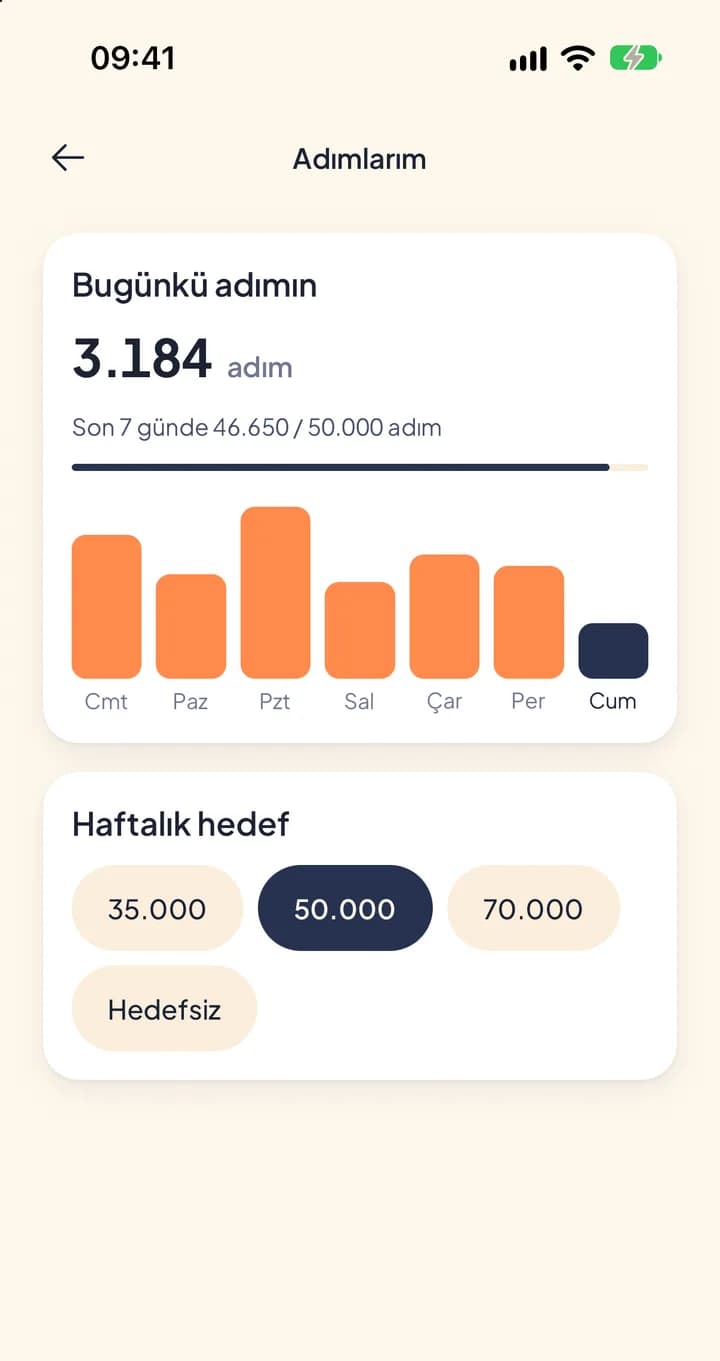
Step counter
Today's steps from your iPhone's motion sensor, with a weekly goal.
 Coming soonAndroid
 Scan with your phone camera to open the App Store.
Walking
Today's steps from your iPhone's motion sensor, with a weekly goal.
Your journal, mood, cycle and tracker records, including saved step counts, are stored on your device. When account backup is available and you are signed in, the app also sends an encrypted copy to our servers to restore and merge your records.
Frequently asked questions
Do you need a smartwatch or fitness tracker to count steps?
Today's steps from your iPhone's motion sensor, with a weekly goal.
Your journal, mood, cycle and tracker records, including saved step counts, are stored on your device. When account backup is available and you are signed in, the app also sends an encrypted copy to our servers to restore and merge your records.
How do you track steps effectively?
Today's steps from your iPhone's motion sensor, with a weekly goal.
Your journal, mood, cycle and tracker records, including saved step counts, are stored on your device. When account backup is available and you are signed in, the app also sends an encrypted copy to our servers to restore and merge your records.
Sources
- NIH PubMed: Validity of activity trackers, smartphones, and phone applications to measure steps in various walking conditions
- NIH PubMed: Validity of smartphones and activity trackers to measure steps in a free-living setting over three consecutive days
- NIH NHLBI: Keep walking: Study finds higher daily step count helps adults live longer
Step counter
Today's steps from your iPhone's motion sensor, with a weekly goal.
Coming soonAndroidScan with your phone camera to open the App Store.