
To calculate your period date, first count your menstrual cycle length: the number of days from the first day of your period to the day before your next period begins. Adding the average of several cycles to the start date of your last period gives you an estimate for your next period. According to the UK National Health Service (NHS), the average cycle is 28 days and can fluctuate slightly from month to month, so treat the prediction as a window of a few days.
How to calculate your period
The entire calculation relies on a single clinical definition. According to the NHS, a menstrual cycle is the interval from the first day of your period to the day before your next period begins. In other words, the first day your bleeding starts is day 1 of your cycle.
Because of this definition, you only need two dates to calculate your cycle: the start date of one period and the start date of the next period. How many days the bleeding itself lasts does not change the cycle length; your period days are simply the opening days of that cycle.
If you do not have past dates recorded, you can start today. Note down the date when your next period begins, and do the same when the following one starts. After a few months, you will have plenty of data to calculate your numbers.
Menstrual cycle calculation: counting the days
You count the total days between two consecutive period start dates. The day the first period starts is included in the count, while the day the next period starts is excluded. Checking the difference between two calendar dates on your phone gives the exact same result.
A three-cycle example:
| Period start date | Next period start date | Cycle length |
|---|---|---|
| June 5 | July 4 | 29 days |
| July 4 | August 1 | 28 days |
| August 1 | August 31 | 30 days |
To avoid mistakes around the ends of months, keep in mind how many days each calendar month has. Between June 5 and July 4, there are 26 days in June and 3 days in July, giving a total of 29 days.
Period date calculation: predicting your next period
To find your average, add your logged cycle lengths together and divide by the number of cycles. In the example above, the cycles lasted 29, 28, and 30 days; the sum is 87 days, which yields an average cycle length of 29 days.
Next, add this average number of days to the start date of your last period. If your last period began on August 31 and your average cycle length is 29 days, your next period is expected around September 29.
The NHS points out that the time between periods averages around 28 days and can lengthen or shorten slightly from one month to the next. Because of this natural variation, it is much more realistic to view the prediction not as a single fixed day, but as a window covering that day along with one or two days before and after. This calculation only estimates when bleeding may start; it cannot be used for contraception or pregnancy prevention.
How to calculate when your cycle is irregular
Averages work best when cycles remain close to one another in duration. According to the NHS, a period can arrive every 21 to 35 days, and if the gap between periods is shorter than 21 days or longer than 35 days, the cycle is considered irregular. If your cycles fluctuate wildly, an average will produce a less precise prediction.
The NHS notes that irregular cycles are most common during puberty and when approaching menopause. Pregnancy, hormonal birth control methods, substantial weight changes, emotional stress, and extreme physical exercise can also alter cycle regularity. The NHS reassures that irregular periods are usually not a sign of disease. Still, in these circumstances, it helps to understand that cycle calculations are rough estimates. For more details, see our guide on irregular menstrual cycle.
We cover typical cycle lengths in how many days is a normal menstrual cycle and describe internal bodily changes across the cycle in menstrual cycle phases.
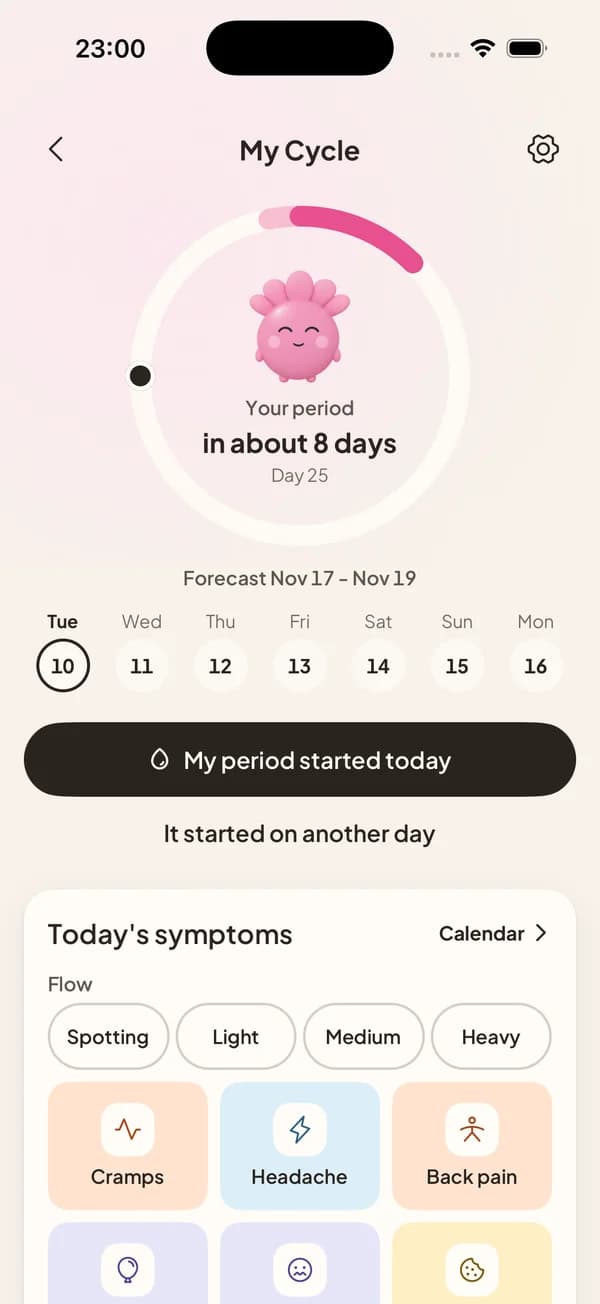
Keep your period calendar in yuuvii
Tap once when your period starts; the next estimate, your symptoms and your mood live in one place. Your entries stay on your phone.
 Coming soonAndroid
 Scan with your phone camera to open the App Store.
When should you see a doctor?
One major benefit of logging dates is spotting shifts early. The NHS recommends consulting a doctor if:
- your period is irregular or your established cycle pattern changes
- your period lasts longer than 7 days
- you experience bleeding between periods
- irregular periods are accompanied by weight changes, fatigue, facial hair growth, or dry or oily skin
- you have missed three consecutive periods
The NHS also emphasizes that bleeding after sexual intercourse or after menopause should always be investigated by a physician. In a medical emergency, call 112 in Europe, 999 in the UK, or 911 in the US.
Periods
Mark your period, tick symptoms and see when the next one is likely to start.
Your journal, mood, cycle and tracker records, including saved step counts, are stored on your device. When account backup is available and you are signed in, the app also sends an encrypted copy to our servers to restore and merge your records.
The estimate is not for contraception. yuuvii is not a medical device and does not diagnose or treat.
Frequently asked questions
Do period bleeding days count when calculating cycle days?
Yes. According to the NHS, the cycle begins on the first day of your period bleeding and ends on the day before the next period starts. The days of active menstrual bleeding are simply the first days of that cycle.
Does the calculation work if my cycle is longer than 35 days?
You can still calculate an average, but the prediction will be less certain. The NHS considers cycles longer than 35 days to be irregular and recommends seeing a doctor if your cycles are consistently irregular.
Sources
- NHS: Periods
- NHS: Periods and fertility in the menstrual cycle
- NHS: Irregular periods
- NHS: Missed or late periods
Keep your period calendar in yuuvii
Tap once when your period starts; the next estimate, your symptoms and your mood live in one place. Your entries stay on your phone.
Coming soonAndroidScan with your phone camera to open the App Store.