To keep a period calendar, note down the day each period starts and the day it ends. The day your period begins is day 1 of your cycle; your cycle concludes on the day before your next period begins. Adding the average of several cycles to your most recent start date gives you a prediction for your next period. Regular tracking also makes it simple to spot changes in your cycle rhythm.
What is a period calendar?
A period calendar is a record where you log your menstrual bleeding days and the intervals between periods. It can be a paper planner, a calendar on your phone, or a dedicated mobile app. According to the UK National Health Service (NHS), tracking your period with an app or in a diary can help you determine whether your periods are irregular.
A calendar serves three practical purposes:
- knowing approximately when your next period is due to start
- observing how much your cycle length naturally varies from month to month
- having an accurate timeline of dates ready when speaking with a doctor
Step by step guide to tracking your period
- Mark the day your bleeding begins. This date is day 1 of your menstrual cycle.
- Mark the day your bleeding stops. According to the NHS, a period can last between 2 and 7 days, most often around 5 days. Flow is usually heaviest during the first 2 days.
- Optionally note daily symptoms. Recording symptoms like cramps, headache, bloating, and fatigue day by day shows you what patterns to anticipate next month.
- Mark the start of your next period. The number of days between two consecutive start dates is your cycle length.
- Continue tracking for several months. A single cycle offers limited insight; observing several cycles side by side reveals your personal rhythm.
What can you record in your calendar?
Logging your start and end dates is all that is required for predictions. Adding a few extra observations makes your calendar even more informative:
- Flow intensity. According to the NHS, bleeding is typically heaviest on the first 2 days. On heavier days blood is bright red, whereas on lighter days it may look pink or brown. An average period involves losing between 20 and 90 ml (about 1 to 5 tablespoons) of blood.
- Physical symptoms. Noting which cycle days cramps, headaches, bloating, or breast tenderness occur prepares you for upcoming cycles.
- Mood changes. Many women experience emotional fluctuations in the days leading up to their period; notes reveal whether this forms a regular pattern for you.
- Changes in birth control. The NHS lists certain hormonal contraceptive methods among the common causes of irregular periods. Logging when you start or switch a method helps you interpret changes in subsequent months.
How to calculate your period calendar
The calculation involves three simple steps:
Cycle length. Count the days starting from the first day of your period up to the day before your next period begins. The start day is included, while the start day of the next period is excluded. For example, if your period starts on March 3 and the next begins on March 31, your cycle lasted 28 days.
Cycle average. Add the lengths of your last few cycles together and divide by the number of cycles. If your cycles were 27, 29, and 28 days, your average is 28 days.
Period prediction. Add your average cycle length to the start date of your last period. If your last period began on March 31 and your average is 28 days, your next period is expected around April 28.
The NHS points out that the time between periods averages around 28 days and can naturally be slightly shorter or longer. Treating the prediction as a window of several days rather than a single rigid day is far more realistic. This calculation only estimates when bleeding may start; it cannot be used for contraception.
How long does a normal menstrual cycle last?
According to the NHS, periods arrive roughly every 28 days in most women, and cycles ranging from 21 to 35 days are common. The NHS classifies any cycle shorter than 21 days or longer than 35 days as irregular. Cycles are more prone to irregularity during puberty and when approaching menopause.
To explore cycle lengths in depth, see how many days does a period last, and to understand causes of irregularity, see irregular menstrual cycle.
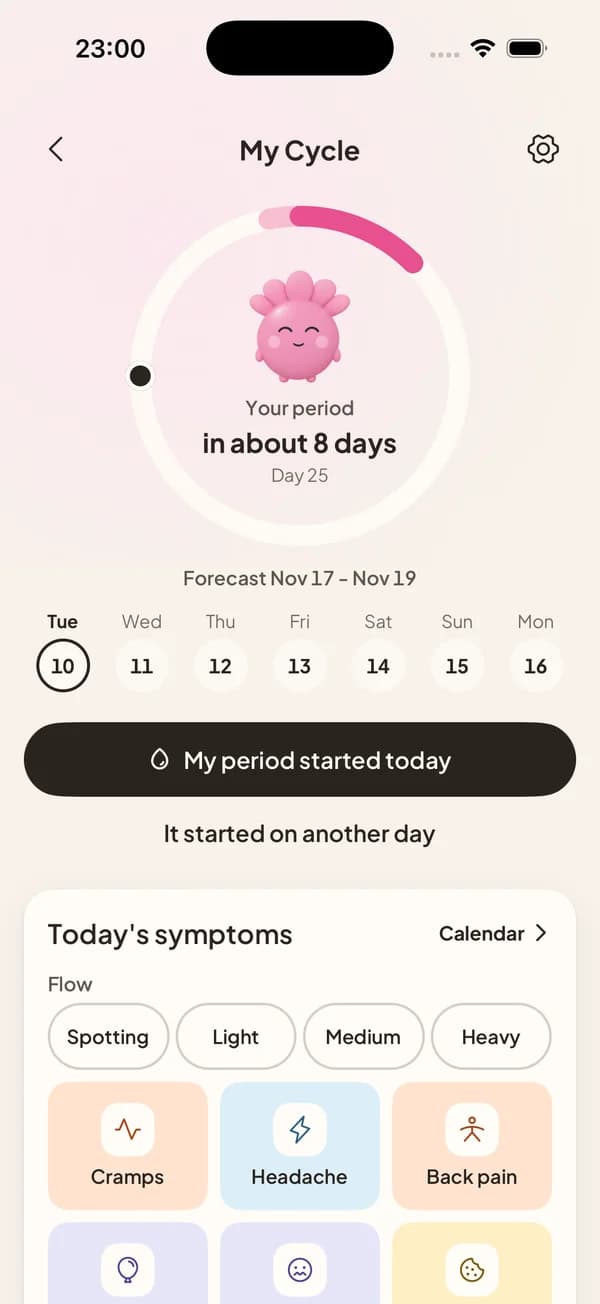
Keep your period calendar in yuuvii
Tap once when your period starts; the next estimate, your symptoms and your mood live in one place. Your entries stay on your phone.
 Coming soonAndroid
 Scan with your phone camera to open the App Store.
What warning signs should you watch for?
A major advantage of tracking is noticing unusual changes early. The NHS recommends consulting a doctor if:
- your periods are irregular
- your period lasts longer than 7 days
- irregular cycles are accompanied by weight changes, fatigue, facial hair growth, or dry or oily skin
- you experience bleeding between periods
The NHS also notes that changes such as periods becoming longer or lighter warrant medical evaluation. If your bleeding has not arrived on the expected date, our guide on why is my period late explains what steps to take.
Periods
Mark your period, tick symptoms and see when the next one is likely to start.
Your journal, mood, cycle and tracker records, including saved step counts, are stored on your device. When account backup is available and you are signed in, the app also sends an encrypted copy to our servers to restore and merge your records.
The estimate is not for contraception. yuuvii is not a medical device and does not diagnose or treat.
Frequently asked questions
Which day does the period calendar start on?
The day your period bleeding starts is day 1 of your cycle. The cycle concludes on the day before your next period begins.
Is an app necessary to track your period?
No. A paper notebook or phone calendar works effectively. The NHS notes that both apps and written diaries are suitable tracking tools. An app simply automates calculating averages and predictions.
Can a period tracker be used for contraception?
No. A period tracker estimates when your next bleeding may begin based on historical averages. Discuss verified contraceptive methods with your healthcare provider.
Sources
Keep your period calendar in yuuvii
Tap once when your period starts; the next estimate, your symptoms and your mood live in one place. Your entries stay on your phone.
Coming soonAndroidScan with your phone camera to open the App Store.