
The NHS, World Health Organization (WHO), and CDC do not mandate a specific daily step count for adults. Instead, they recommend at least 150 minutes of moderate intensity physical activity per week, and brisk walking counts toward this target. In an NIH funded study tracking over 2,000 middle aged adults, individuals walking at least 7,000 steps daily had a 50 to 70 percent lower mortality risk compared to those taking fewer steps.
How many steps should you take daily?
There is no universal official daily step prescription. Physical activity guidelines from the NHS, WHO, and CDC define weekly exercise goals in minutes rather than steps. The National Heart, Lung, and Blood Institute (NHLBI) of the US National Institutes of Health (NIH) similarly notes that the exact step threshold required for optimal health benefits remains an area of ongoing research.
| Organization | Weekly adult recommendation | Walking context |
|---|---|---|
| NHS | At least 150 minutes of moderate or 75 minutes of vigorous exercise; muscle strengthening on at least 2 days | Brisk walking qualifies as moderate exercise |
| CDC | At least 150 minutes of moderate intensity exercise (e.g. 30 minutes, 5 days per week); 2 days of muscle strengthening | Brisk walking is highlighted as an ideal example |
| WHO | At least 150 minutes of moderate physical activity | Walking is listed among the most accessible daily activities |
The NHS advises adults to engage in physical movement daily, spreading exercise across 4 to 5 days or every day. The NHS also urges reducing prolonged sitting and breaking up sedentary periods with light activity. As the WHO emphasizes, any amount of physical activity is better than none.
Scientific research on daily step counts and mortality
The most reliable insights on step numbers come from cohort studies. In research highlighted by the NHLBI, scientists followed more than 2,000 middle aged Black and white men and women for more than 11 years using accelerometers.
Key study findings include:
- Participants taking at least 7,000 steps daily had a 50 to 70 percent lower risk of premature mortality compared to those taking fewer steps.
- Walking speed or stepping intensity did not independently influence mortality risk.
These findings stem from middle aged participants in a longitudinal cohort and do not mean that 7,000 is an inflexible rule, but they show substantial health gains well before 10,000 steps.
Is 10,000 steps a day necessary?
According to the NHLBI, while popular fitness trackers commonly promote 10,000 steps daily, scientific evidence increasingly demonstrates that meaningful health benefits occur at lower counts. The NHS, WHO, and CDC guidelines do not specify 10,000 steps as an official public health threshold.
You do not need to view 10,000 steps as an all or nothing standard. Public health recommendations are grounded in cumulative weekly minutes of movement.
What is brisk walking and how is it measured?
The NHS notes that brisk walking counts toward your 150 minute weekly target. The NHS defines brisk walking as walking at roughly 3 miles per hour (about 4.8 km/h), which is faster than a casual stroll. A practical rule of thumb is the talk test: if you can talk comfortably while walking but cannot sing, you are walking briskly.
You do not need to walk for hours at a time. The NHS states that a brisk 10 minute daily walk offers real health benefits and counts directly toward your weekly goal. The NHS Better Health initiative notes that even one minute of brisk walking provides health value. For more details on benefits, read steps a day for weight loss.
Step counter
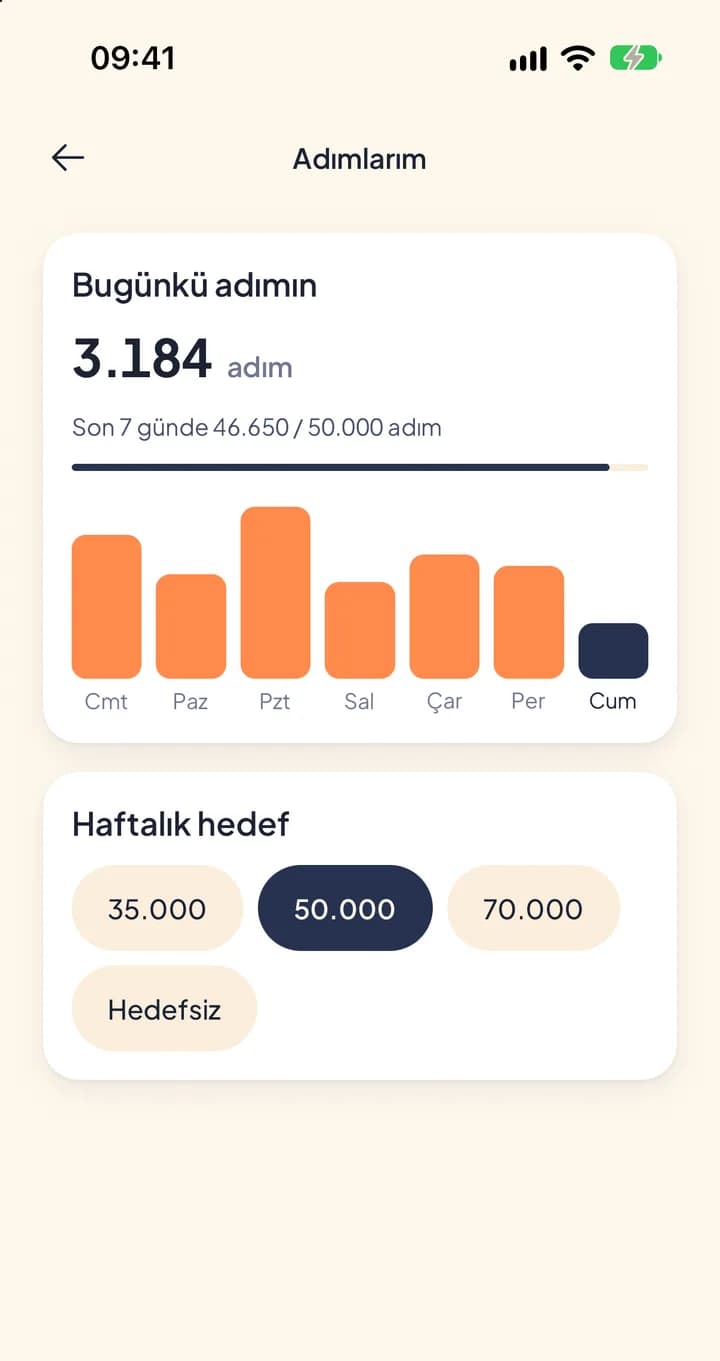
Today's steps from your iPhone's motion sensor, with a weekly goal.
 Coming soonAndroid
 Scan with your phone camera to open the App Store.
Walking
Today's steps from your iPhone's motion sensor, with a weekly goal.
Your journal, mood, cycle and tracker records, including saved step counts, are stored on your device. When account backup is available and you are signed in, the app also sends an encrypted copy to our servers to restore and merge your records.
When to seek medical advice
The NHS recommends speaking with a doctor before starting a new exercise regimen if you have been inactive for an extended period or have cardiovascular concerns. Adjust physical intensity to your personal fitness level. If you are pregnant and were inactive prior to pregnancy, avoid vigorous exercise without medical consultation.
Call emergency services immediately if you experience chest pain symptoms. In the US call 911; in the UK call 999; in Europe call 112:
- Sudden, severe, or persistent pressure, tightness, or pain in your chest
- Pain radiating to your arms, neck, jaw, back, or abdomen
- Chest discomfort accompanied by shortness of breath, dizziness, sweating, or nausea
Frequently asked questions
Is there a formula to calculate individual daily step needs?
Public health authorities do not specify individualized step formulas. The NHLBI notes that exact requirements vary. A practical approach is aiming for the established baseline of 150 minutes of moderate activity weekly.
How can I check how many steps I walk each day?
Today's steps from your iPhone's motion sensor, with a weekly goal.
Your journal, mood, cycle and tracker records, including saved step counts, are stored on your device. When account backup is available and you are signed in, the app also sends an encrypted copy to our servers to restore and merge your records.
Sources
- NHS: Physical activity guidelines for adults aged 19 to 64
- NHS: Walking for health
- NHS Better Health: Get active
- WHO: Physical activity
- CDC: Adult Activity: An Overview
- NIH NHLBI: Keep walking: Study finds higher daily step count helps adults live longer
- NHS: Chest pain
Step counter
Today's steps from your iPhone's motion sensor, with a weekly goal.
Coming soonAndroidScan with your phone camera to open the App Store.