
According to the UK National Health Service (NHS), a period occurs roughly every 28 days for most women, and arriving every 21 to 35 days is also common. In other words, periods usually arrive about once a month. If the interval between periods is shorter than 21 days or longer than 35 days, the cycle is considered irregular. Periods can be more irregular during the first years after they start and when approaching menopause.
How often does a period occur?
According to the NHS, periods arrive roughly every 28 days in most women. Arriving slightly more frequently or less frequently is also common: cycles between 21 and 35 days fall within this expected range.
This time interval is counted from the first day of bleeding. The NHS defines a menstrual cycle as the time from the first day of your period to the day before your next period begins. For example, if your period starts on March 1 and the next one begins on March 29, your cycle lasted 28 days, regardless of how many days the bleeding itself lasted.
We explain how to calculate your own cycle numbers with examples in period calculator.
How many days between periods is normal and should every month be identical?
You do not need to expect the exact same number of days every month. The NHS states that the average cycle is around 28 days and that cycles can occasionally shorten or lengthen slightly. Having a 27-day cycle one month and a 30-day cycle the next month is therefore completely common.
What the NHS classifies as irregular is different: if the time between periods is fewer than 21 days or more than 35 days, the cycle is considered irregular. According to the NHS, an irregular period is generally not a sign of a medical problem, but if your usual pattern has shifted, speaking with a doctor is recommended.
A quick summary of these ranges:
- In most women, around28 days
- Common range21-35 days
Source: NHS
The NHS considers any cycle outside this range, namely shorter than 21 days or longer than 35 days, to be irregular.
How many months between periods is normal?
When cycles range between 21 and 35 days, periods occur roughly once a month. If your period arrives only once every two or three months, the gap between periods has exceeded 35 days; the NHS classifies this as an irregular cycle.
The NHS lists common reasons for late or missed periods:
- pregnancy
- stress
- perimenopause
- polycystic ovary syndrome (PCOS)
- sudden weight loss or excess weight
- extreme exercise
- certain hormonal birth control methods
- breastfeeding
The NHS recommends seeing a doctor if you have missed three periods in a row. If there is a chance of pregnancy, the NHS notes that most home pregnancy tests can be carried out from the first day of a missed period. Additional details on cycle delays can be found in our guide on why is my period late.
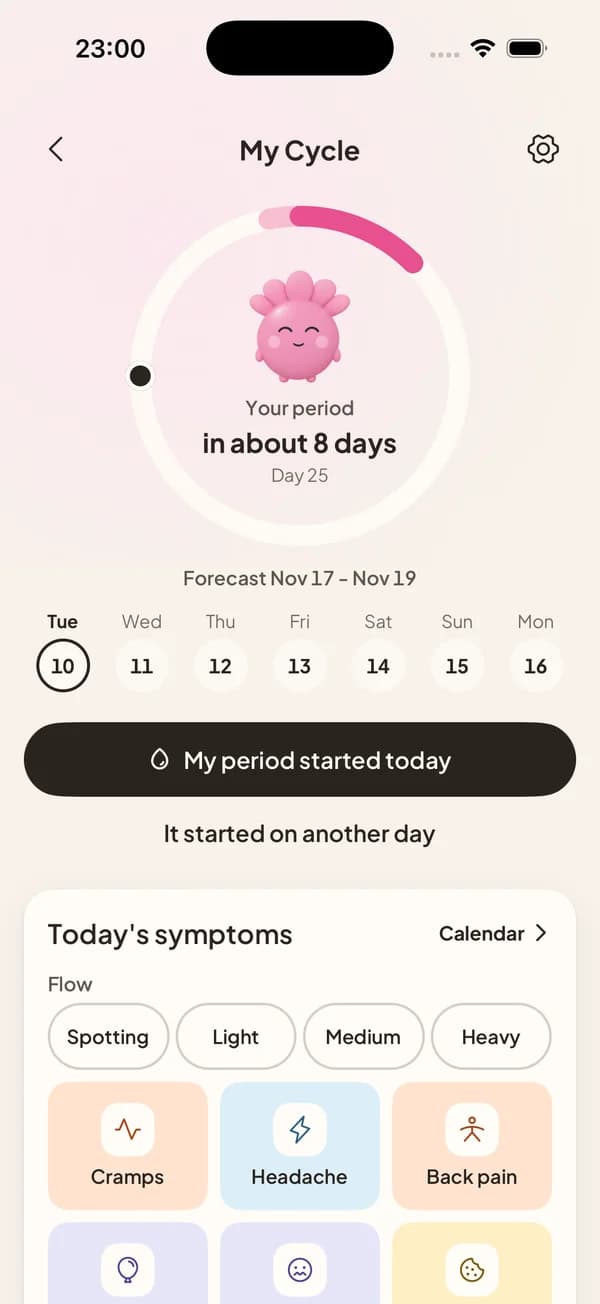
Keep your period calendar in yuuvii
Tap once when your period starts; the next estimate, your symptoms and your mood live in one place. Your entries stay on your phone.
 Coming soonAndroid
 Scan with your phone camera to open the App Store.
Does period frequency change with age?
Yes, cycle frequency can shift over time. According to the NHS, irregular periods are most commonly experienced during two phases: the early teenage years when periods first start, and when approaching menopause.
The early years. According to the NHS, periods typically begin around age 12, though for some girls they can start as early as age 8. Most girls' cycles become regular between the ages of 16 and 18. Because of this, fluctuations in cycle length from month to month are very common in the beginning.
Approaching menopause. Perimenopause usually begins between ages 45 and 55. According to the NHS, periods during this time may arrive more often or less often, bleeding may become heavier or lighter, and eventually periods stop altogether. We discuss this transition further in period symptoms during perimenopause.
When should you see a doctor?
The NHS recommends consulting a doctor if:
- your period is irregular or your familiar cycle pattern has changed
- you have missed three consecutive periods
- your period has not started by the age of 15
- your period lasts longer than 7 days
- you experience bleeding between periods
- irregular periods are accompanied by weight changes, fatigue, facial hair growth, or sudden changes in skin texture
- your cycles are irregular and you are struggling to conceive
The NHS also emphasizes that bleeding occurring after sexual intercourse or after menopause should always be evaluated by a healthcare professional. In a medical emergency, call 112 in Europe, 999 in the UK, or 911 in the US.
Periods
Mark your period, tick symptoms and see when the next one is likely to start.
Your journal, mood, cycle and tracker records, including saved step counts, are stored on your device. When account backup is available and you are signed in, the app also sends an encrypted copy to our servers to restore and merge your records.
The estimate is not for contraception. yuuvii is not a medical device and does not diagnose or treat.
Frequently asked questions
Is it normal to have two periods in one month?
If the interval between periods is shorter than 21 days, the NHS considers the cycle irregular. If you experience unexpected bleeding between periods, the NHS recommends being examined by a doctor.
Do birth control pills alter period frequency?
The NHS lists certain hormonal contraceptive methods among the common causes of irregular or delayed periods. Discuss any specific questions regarding your birth control method with your healthcare provider.
Sources
- NHS: Periods
- NHS: Irregular periods
- NHS: Missed or late periods
- NHS: Periods and fertility in the menstrual cycle
- NHS: Doing a pregnancy test
- NHS: Symptoms of menopause and perimenopause
Keep your period calendar in yuuvii
Tap once when your period starts; the next estimate, your symptoms and your mood live in one place. Your entries stay on your phone.
Coming soonAndroidScan with your phone camera to open the App Store.