A period lasts between 2 and 7 days for most women, most often around 5 days. The time between the start of two consecutive periods, known as the menstrual cycle, averages 28 days, with 21 to 35 days being common. If your period lasts longer than 7 days or if the interval between periods falls outside this range, speaking with a doctor is recommended.
What is a menstrual cycle?
The menstrual cycle is the interval from the day your period starts to the day before your next period begins. The UK National Health Service (NHS) defines day 1 of the cycle as the first day of your period bleeding, and the final day of the cycle as the day before your next period starts.
There are two distinct numbers here that are frequently confused:
- Cycle length: the total number of days between the start of two consecutive periods. Your period bleeding days are included in this number.
- Period duration: how many days the active bleeding lasts.
For example, if your period starts on March 3 and your next period starts on March 31, your cycle lasted 28 days (March 3 through March 30). If your active bleeding lasted 5 days during that time, your period duration was 5 days.
How often does a period occur?
According to the NHS, periods arrive roughly every 28 days in most women. Arriving slightly more frequently or less frequently is also common; cycles between 21 and 35 days fall within this typical range. Your cycle does not have to be the exact same length every month: the NHS explains that the average is around 28 days and that cycles can occasionally shorten or lengthen slightly.
A practical way to think about these ranges:
- Cycles shorter than 21 days: the NHS classifies this as irregular bleeding.
- Cycles between 21 and 35 days: the common, expected range.
- Cycles longer than 35 days: this is also classified as irregular.
According to the NHS, irregular cycles are more likely during puberty, when periods first begin, and as you approach menopause. Periods continue until menopause; according to the NHS, menopause typically arrives between the mid-40s and mid-50s, and periods do not usually stop overnight, but taper off gradually over months or years. We explore reasons for cycle changes in our article on irregular menstrual cycle.
How many days does a period last and what is the maximum normal duration?
According to the NHS, a period can last between 2 and 7 days, most often around 5 days. Bleeding is usually heaviest during the first 2 days. On the heaviest days blood appears bright red, while on lighter days it may look pink or brown.
During an average period, roughly 20 to 90 ml (about 1 to 5 tablespoons) of blood is lost; some women experience heavier bleeding. The NHS notes that if you need to change your pad or tampon every 1 to 2 hours or if your bleeding lasts longer than 7 days, your period may be heavy.
When asking "what is the maximum normal duration," the clinical threshold from the NHS is 7 days: if your period lasts longer than 7 days, that is one of the situations where consulting a doctor is advised. An isolated variation is different from a persistent pattern; recording the duration across several cycles gives your doctor clear, objective evidence.
How to find your personal cycle length
You cannot determine your cycle pattern from a single isolated month; an average across several cycles gives a far more accurate picture.
- Record the start dates of your last few periods.
- Count the days between consecutive start dates. The first day of the earlier period is included, while the start day of the next period is excluded.
- Calculate the average of these numbers.
A three-cycle example:
| Period start date | Next period start date | Cycle length |
|---|---|---|
| March 3 | March 31 | 28 days |
| March 31 | April 30 | 30 days |
| April 30 | May 27 | 27 days |
In this example, the average cycle length is approximately 28 days, fluctuating by 1 to 2 days from month to month. The NHS notes that tracking your period with an app or in a notebook helps you see whether your cycle is irregular. For a step by step approach, see how to use a period tracker.
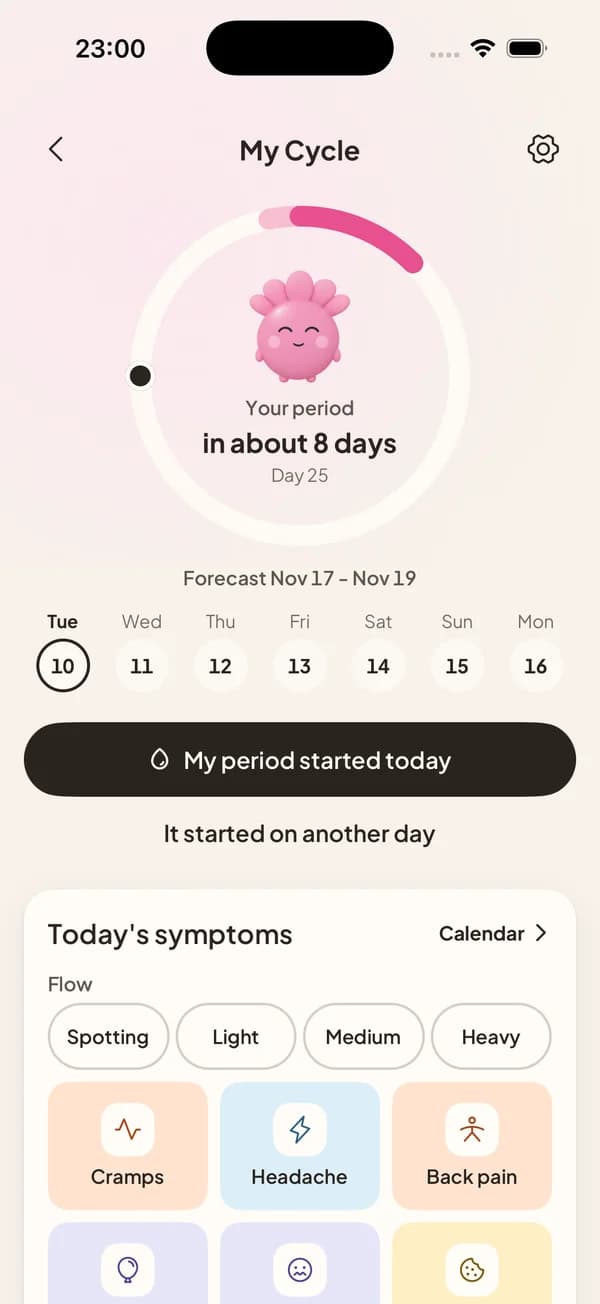
Keep your period calendar in yuuvii
Tap once when your period starts; the next estimate, your symptoms and your mood live in one place. Your entries stay on your phone.
 Coming soonAndroid
 Scan with your phone camera to open the App Store.
When should you see a doctor?
The NHS recommends consulting a doctor if:
- your periods are irregular,
- your period lasts longer than 7 days,
- irregular periods are accompanied by weight changes, fatigue, facial hair growth, or dry or oily skin,
- you experience bleeding between periods,
- your periods are irregular and you are finding it difficult to conceive.
If your familiar cycle pattern changes, the NHS also suggests talking with a doctor. If your period did not arrive when expected, our guide on why is my period late covers common causes of delay.
Periods
Mark your period, tick symptoms and see when the next one is likely to start.
Your journal, mood, cycle and tracker records, including saved step counts, are stored on your device. When account backup is available and you are signed in, the app also sends an encrypted copy to our servers to restore and merge your records.
The estimate is not for contraception. yuuvii is not a medical device and does not diagnose or treat.
Frequently asked questions
How many days should a menstrual cycle last?
According to the NHS, the average cycle length is 28 days, with 21 to 35 days being common. Cycles shorter than 21 days or longer than 35 days are considered irregular.
Are period bleeding days included in the cycle?
Yes. The cycle begins on the first day of your period bleeding and ends on the day before your next period begins; the bleeding days are simply the first days of that cycle.
Does your cycle need to be identical every month?
No. The NHS explains that the average cycle is around 28 days and that cycles can naturally be slightly shorter or longer from one month to the next.
Sources
Keep your period calendar in yuuvii
Tap once when your period starts; the next estimate, your symptoms and your mood live in one place. Your entries stay on your phone.
Coming soonAndroidScan with your phone camera to open the App Store.