NHS and US National Institutes of Health (NIH) skin guidance centers on three essential steps: gentle cleansing, moisturizing and sun protection. In the morning, wash your face, moisturize immediately while damp, and apply broad-spectrum sunscreen before going outdoors. In the evening, remove makeup and daily grime, then moisturize. Discuss extra active products with a dermatologist.
How to build a skincare routine
The simplest and most sustainable way to establish a daily skincare routine is to start with the foundational steps endorsed across clinical guidelines. The UK National Health Service (NHS) recommends washing acne-prone skin twice daily using a gentle cleanser, and emphasizes thoroughly removing makeup at the end of every day. Similarly, the National Institutes of Health (NIH) healthy skin guidance recommends cleansing morning and night with a mild wash, followed by daily hydration.
The third vital pillar is sun protection. The US National Institute on Aging (NIA) identifies cumulative ultraviolet sun exposure as a leading factor in premature skin aging and textural changes. The NHS recommends choosing a broad-spectrum sunscreen offering at least SPF 30 and a minimum 4-star UVA rating.
When designing your regimen, evaluate two practical questions for each product: does it belong in the morning or evening, and can you maintain it consistently every single day? Committing to simple, sustainable steps prevents your skincare from becoming burdensome.
What order should you apply skincare products?
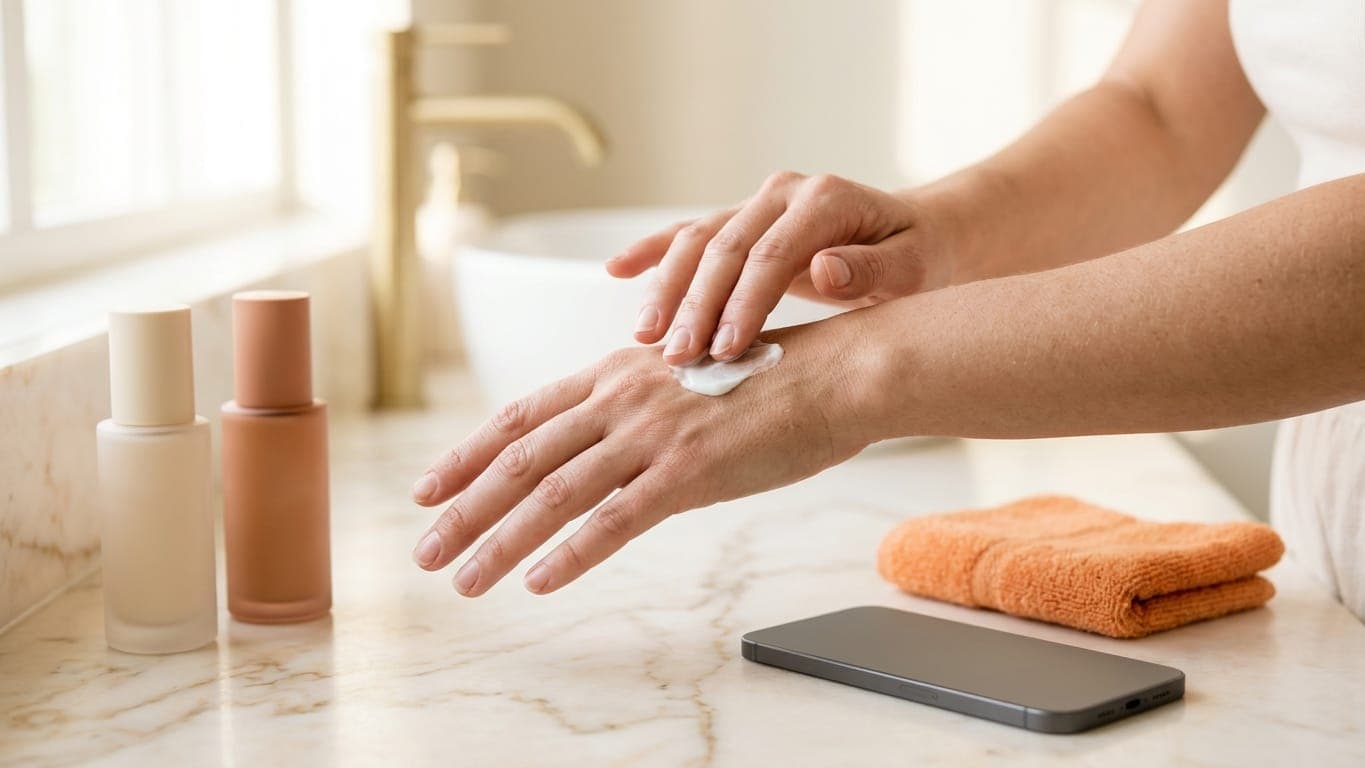
Clinical guidance provides clear directions regarding the sequence between cleansing and hydration. According to the NHS guide on emollients and moisturizers, hydrating creams work most effectively when applied immediately after washing, because the skin barrier needs moisture replenishment right away. The NHS advises smoothing cream on immediately after gently patting your skin dry. According to MedlinePlus, the health portal of the US National Library of Medicine, moisturizers function by trapping existing moisture in the epidermal layers, making them perform best when applied to slightly damp skin.
Sunscreen placement is dictated by its timing. The NHS advises that if you will be outdoors long enough to risk burning, you should apply sunscreen twice: 30 minutes before leaving home, and again just before stepping outside. Consequently, sunscreen always represents the final step of your morning routine before heading out. The NHS reminds individuals to cover the face, neck, and ears, and to reapply sunscreen every two hours and immediately after swimming or heavy sweating.
The situation is different for auxiliary products such as toners, serums, and masks. The clinical NHS and NIH guidelines we reviewed do not prescribe a rigid universal sequence for these products. MedlinePlus simply advises avoiding harsh alcohol-based toners and astringents that strip natural lipids from the skin. If you wish to incorporate concentrated serums or active treatments, consult a dermatologist to determine which ingredients suit your skin barrier and where they fit into your schedule.
Morning and evening skincare routine table
| Step | Optimal timing | Clinical rationale and source guidance |
|---|---|---|
| Makeup removal | Evening | The NHS advises thoroughly removing all cosmetics at the end of the day. MedlinePlus warns never to sleep with makeup on. |
| Facial cleansing | Morning and evening | The NHS recommends washing twice daily with a mild cleanser, avoiding aggressive scrubbing. |
| Moisturizing | Morning and evening | The NHS advises applying moisturizer immediately after patting skin dry to lock in water. |
| Sunscreen protection | Morning, before going outdoors | The NHS recommends broad-spectrum sunscreen with at least SPF 30 and 4-star UVA protection, reapplied every two hours. |
How many steps should a skincare routine have?
The clinical evidence we reviewed does not endorse arbitrary multi-step routines. The essential core consists of three tasks: gentle cleansing, moisturizing, and sun protection, complemented by evening makeup removal. Before expanding your cabinet with additional cosmetics, consider these clinical precautions:
- The NIA advises maintaining healthy skepticism toward anti-aging marketing claims that promise to erase wrinkles. Most over the counter creams are regulated as cosmetics rather than medications, meaning clinical trials in humans are not legally required prior to sale.
- The NHS and MedlinePlus advise choosing non-comedogenic products that do not clog pores, though MedlinePlus cautions that even non-comedogenic formulations can trigger breakouts in sensitive skin.
- For dry skin, MedlinePlus advises avoiding products formulated with alcohol, synthetic fragrances, or artificial dyes.
- The NHS advises never scrubbing facial skin vigorously and never squeezing or picking spots, as friction aggravates inflammation and picking causes permanent scarring.
- MedlinePlus recommends keeping showers short (5 to 10 minutes) with warm rather than hot water to preserve natural skin oils.
The NIA recommends discussing safe, evidence-based skincare choices with a dermatologist or family physician to determine your skin type and identify appropriate ingredients. If you are seeking a digital tool to manage your habits, read our review of how to start a skincare routine.
Skincare routine
This tracker is not available in yuuvii 2.0.1. You can read articles on this topic here.
Skincare
This tracker is not available in yuuvii 2.0.1. You can read articles on this topic here.
When should you see a doctor?
The NHS recommends consulting a general practitioner or dermatologist for acne in the following circumstances:
- Over the counter cleansing and self-care measures have failed to improve your skin after several months
- You develop numerous acne lesions, or spots become deep, painful, cystic, or leave permanent scars
- You notice signs of skin infection, such as spreading redness, heat, swelling, or pus
- Acne causes emotional distress, social withdrawal, or affects your mental health
MedlinePlus advises seeking medical care for dry skin if you experience severe itching without a visible rash, dryness that disrupts your sleep, open sores or infections from scratching, or dry skin that fails to respond to home care.
The NHS strongly advises contacting a doctor as soon as possible if you notice a new mole, skin growth, or unusual lump. The same urgency applies if an existing mole, freckle, or skin patch changes in size, shape, color, or begins bleeding, itching, or crusting.
Frequently asked questions
I want to start a skincare routine, where should I begin?
Start with three foundational habits: wash your face gently morning and evening, moisturize immediately after patting dry, and apply broad-spectrum sunscreen each morning before going outdoors. These core steps represent the consensus across NHS and NIH guidelines. Speak with a doctor before introducing specialized active treatments.
What should an evening skincare routine look like?
The NHS recommends thoroughly removing makeup at the end of the day and cleansing your face with a mild, non-abrasive wash. Smooth on moisturizer while your skin remains slightly damp to lock in overnight hydration. Sunscreen is reserved exclusively for mornings and daytime outdoor exposure.
Sources
- NHS: Acne
- NHS: Emollients
- NHS: Sunscreen and sun safety
- MedlinePlus: Acne, self-care
- MedlinePlus: Dry skin, self-care
- NIH: Healthy Skin
- NIA: Skin Care and Aging
Skincare routine
This tracker is not available in yuuvii 2.0.1. You can read articles on this topic here.