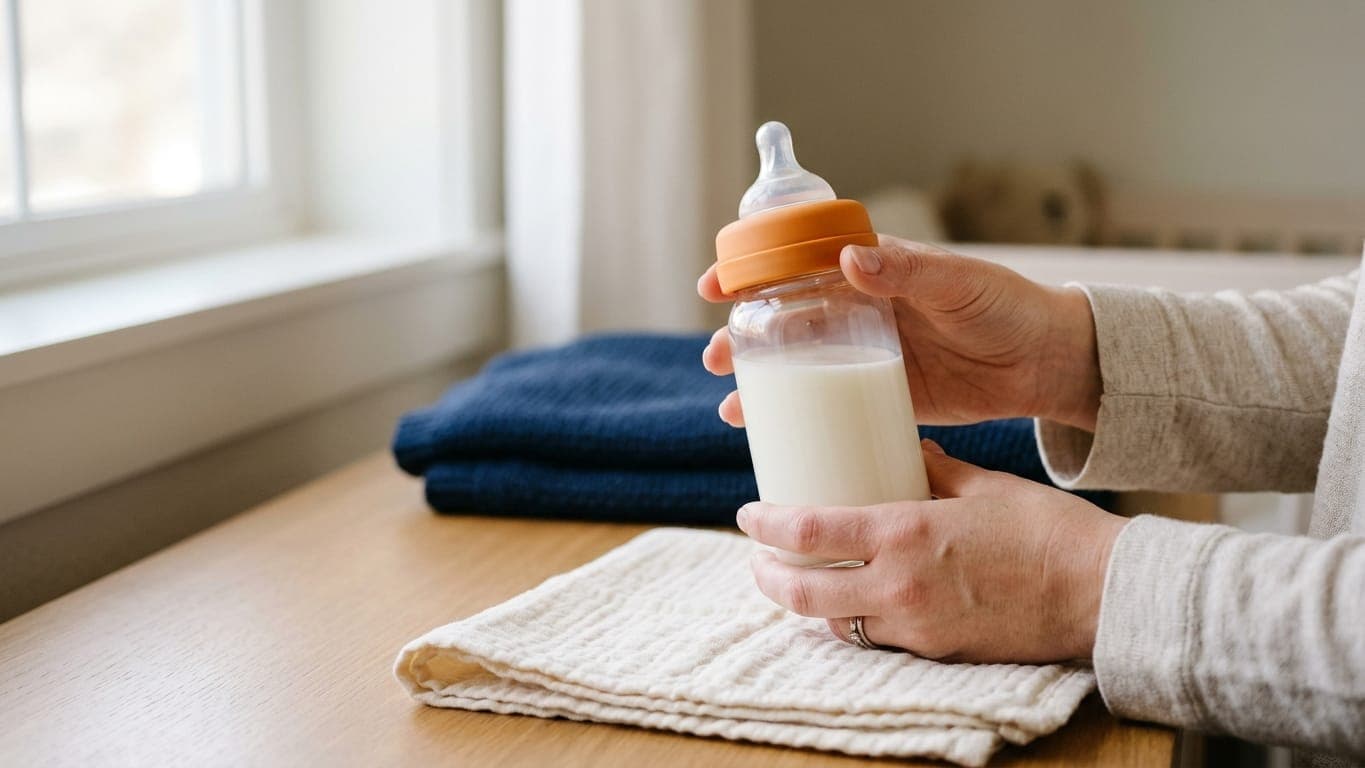
How much milk a baby drinks depends on age, weight, and daily appetite. According to the American Academy of Pediatrics (AAP), formula fed infants consume 30 to 60 ml per feeding during the first week, 90 to 120 ml by the end of the first month, and 180 to 240 ml at 6 months. For breastfed babies, milk volume is not measured; the NHS advises checking weight gain and wet diapers.
How much milk does a newborn drink?
During the first few days of life, infant stomach capacity is very small. According to the UK National Health Service (NHS), newborns require small feeding volumes that vary naturally from baby to baby. In breastfeeding, the initial thick yellow milk (colostrum) is nutrient concentrated; the NHS notes that a newborn needs only about a teaspoon per feed initially.
The American Academy of Pediatrics (AAP) states that bottle fed newborns generally drink no more than 30 to 60 ml (1 to 2 ounces) per feeding during their first week. Note that 1 cc equals 1 ml.
Formula feeding amounts by age
The AAP outlines standard formula amounts per feeding:
- First week30-60 ml
- End of first month90-120 ml
- 6 months180-240 ml
Source: AAP
Feeding frequency also changes as your baby grows:
- First week: on demand, whenever showing hunger cues
- End of first month: roughly every 3 to 4 hours
- 6 months: 4 to 5 feedings per 24 hour period
According to the AAP, on average an infant drinks about 75 ml of formula per day for each pound (453 grams) of body weight, generally capping at 960 ml in 24 hours. The AAP emphasizes letting your baby guide intake rather than forcing them to finish every bottle. If your infant consistently demands significantly more or less than these ranges, consult your pediatrician.
The NHS points out that babies feed according to appetite and may not finish every bottle. Offering an oversized bottle does not mean a baby will sleep longer between feedings.
How much breast milk does a baby drink?
When breastfeeding, you cannot see volume in milliliters, and measuring is not necessary. The NHS emphasizes that a breastfed baby cannot be overfed. Newborn stomachs are small, meaning babies feed frequently; they may easily be ready for more milk soon after a feeding session.
During early weeks, babies typically nurse every 1 to 3 hours, totaling at least 8 to 12 feedings in 24 hours. Feeding intervals gradually space out as milk supply stabilizes. The NHS terms this responsive feeding: nursing whenever the baby shows hunger cues for as long as they need.
Recognizing infant hunger cues
According to the NHS, early hunger cues include:
- Restlessness and squirming
- Sucking on hands, fists, or fingers
- Murmuring or making small sucking sounds
- Turning the head and opening the mouth (rooting reflex)
Crying is a late hunger cue. The NHS advises feeding during early signs, as a distressed, crying baby finds it harder to latch effectively.
Baby tracker
This tracker is not available in yuuvii 2.0.1. You can read articles on this topic here.
How to tell if your baby is getting enough milk
The NHS highlights consistent weight gain and dirty diapers as the most reliable indicators:
- First 48 hours: Breastfed infants typically produce only 2 to 3 wet diapers and pass dark, sticky meconium stools.
- Weight recovery: Losing some birth weight during the first 3 to 4 days is normal; infants usually regain their birth weight within 10 to 14 days.
- Wet diapers: After the first few days, expect at least 6 heavy wet diapers per 24 hours, with pale, clear urine.
- Bowel movements: By day 4, breastfed babies produce at least 2 soft yellow stools daily. Formula fed babies produce pale yellow or yellowish brown stools at least once daily.
Audible swallowing, rhythmic nursing, and relaxed hands after feeding also show contentment.
When to seek medical advice
The NHS advises contacting your midwife, health visitor, or pediatrician promptly if you are concerned about feeding volume or slow weight gain. Seek emergency medical attention if:
- Your baby is not feeding or has stopped feeding
- There are no wet diapers for 12 hours
- The baby has been vomiting persistently for 24 hours or vomits green, black, or bloodstained fluid
- The baby is unusually floppy, difficult to wake, or unresponsive
- The baby has a weak, high pitched, or continuous cry
- An infant under 3 months has a fever of 38 degrees Celsius or higher
- The baby exhibits rapid, strained, or grunting breathing
In an emergency, call 911 in the US, 999 in the UK, or 112 in Europe.
Baby development
This tracker is not available in yuuvii 2.0.1. You can read articles on this topic here.
Frequently asked questions
Is my baby hungry if they leave milk in the bottle?
Not necessarily. The NHS notes that infants feed according to their immediate appetite. As long as weight gain is steady and diaper output is normal, leaving milk is normal.
Can a breastfed baby be given too much milk?
According to the NHS, breastfed babies naturally regulate their intake and cannot be overfed at the breast.
Sources
- NHS: Formula milk: common questions
- NHS: Breastfeeding: the first few days
- NHS: Your breastfeeding questions answered
- NHS: Breastfeeding: is my baby getting enough milk?
- NHS: When to get urgent medical help for babies and children under 5
- AAP HealthyChildren: Amount and Schedule of Baby Formula Feedings
Baby tracker
This tracker is not available in yuuvii 2.0.1. You can read articles on this topic here.