
According to the UK National Health Service (NHS), most home pregnancy tests can be carried out from the first day of a missed period. If you do not know when your period was due, take the test at least 21 days after unprotected sexual intercourse. A positive result is almost certainly correct. If the result is negative and your period still has not arrived, wait a few days and repeat the test; if the second test is also negative, consult a doctor.
How many days after a missed period should you take a test?
There is no need to wait a prolonged time. According to the NHS, most home pregnancy tests can be taken from the first day your period is late, which is the day after your period was due to arrive. The NHS notes that some ultra-sensitive tests can detect pregnancy even before your period is late. Always check the instruction leaflet included with your test kit, as directions differ between brands.
The critical factor is knowing when your period was actually due. If your cycles are regular, you find your expected date by adding your average cycle length to the first day of your last period. If your cycles are irregular or you do not remember your dates, the advice from the NHS is clear: take the test at least 21 days after unprotected sex.
You do not have to test first thing in the morning. According to the NHS, urine can be tested at any time of day. Test kits are readily available over the counter at pharmacies and supermarkets.
How does a pregnancy test work?
Pregnancy tests detect the hormone hCG (human chorionic gonadotropin) in your urine. According to the NHS, the body begins producing this hormone around 6 days after fertilization. Most kits include one or two test sticks; you hold the absorbent tip in your urine stream or dip it in a collected sample, and the result appears within a few minutes.
You can still take a pregnancy test if you use hormonal contraception, such as birth control pills. According to the NHS, hormonal contraceptives do not interfere with how pregnancy test kits work. The NHS also reminds that no contraceptive method is completely 100% effective: if you suspect you might be pregnant, take a test.
How many days late means you could be pregnant?
The number of days a period is late does not by itself prove pregnancy. While the NHS states that a missed period is often an early sign of pregnancy, there are several other common explanations for late bleeding: stress, sudden weight loss or excess weight, excessive exercise, certain hormonal contraceptives, breastfeeding, and perimenopause. We explore these alternative factors in why is my period late.
According to the NHS, early pregnancy symptoms usually emerge around weeks 4 to 6 of pregnancy and not everyone experiences them. Certain signs, like breast tenderness, can feel very similar to premenstrual sensations. For this reason, taking a test is the only reliable way to know. The situation where symptoms are present but bleeding is absent is explored in period symptoms but no period.
The test was negative but my period has not arrived
According to the NHS, home pregnancy tests are accurate when instructions are followed correctly. However, a negative result is generally less reliable than a positive one. A false negative can occur if you test too early, if instructions are not followed precisely, or if you are taking specific medications.
If your test is negative but you still believe you might be pregnant, wait a few days and repeat the test. If the second test is also negative and your period still has not arrived, make an appointment with a doctor.
If the test is positive
According to the NHS, a positive pregnancy test result is almost always correct. Contact a doctor or midwife to arrange your early antenatal care appointments. The NHS advises seeking immediate medical support if you think you could be pregnant and develop vaginal bleeding, abdominal pain, or pelvic discomfort.
If you are uncertain about whether you wish to continue the pregnancy, the NHS highlights that you can access confidential counselling from healthcare professionals.
When should you see a doctor?
The NHS recommends making an appointment to see a doctor if:
- your second pregnancy test is negative and your period still has not arrived
- you have missed three consecutive periods
- you missed a period and notice other symptoms like weight changes, fatigue, facial hair growth, or dry or oily skin
- your menstrual cycle has become irregular
If there is any possibility of pregnancy and you develop sharp abdominal pain, pelvic pain, or vaginal bleeding, do not delay seeking medical care. In an emergency, call 112 in Europe, 999 in the UK, or 911 in the US.
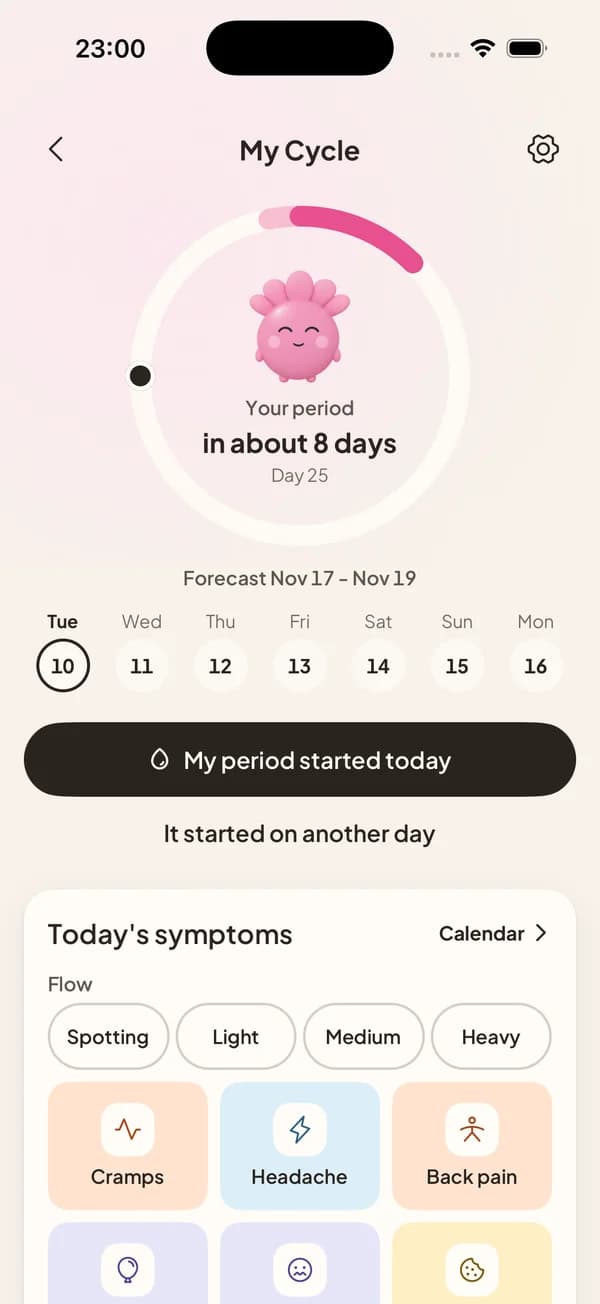
Keep your period calendar in yuuvii
Tap once when your period starts; the next estimate, your symptoms and your mood live in one place. Your entries stay on your phone.
 Coming soonAndroid
 Scan with your phone camera to open the App Store.
Periods
Mark your period, tick symptoms and see when the next one is likely to start.
Your journal, mood, cycle and tracker records, including saved step counts, are stored on your device. When account backup is available and you are signed in, the app also sends an encrypted copy to our servers to restore and merge your records.
The estimate is not for contraception. yuuvii is not a medical device and does not diagnose or treat.
Frequently asked questions
Can you take a pregnancy test before a missed period?
According to the NHS, some highly sensitive tests can detect hCG before your period is due. However, most standard tests are designed to be taken from the first day of a missed period. Testing early increases the risk of a false negative result.
Should you test with first morning urine?
According to the NHS, urine can be tested at any time of day. However, always review the instructions for your specific brand, as some recommend morning testing for early detection.
Do birth control pills affect test accuracy?
According to the NHS, hormonal contraceptives like the birth control pill do not interfere with pregnancy test results.
How many days of delay is considered normal?
The NHS considers cycles shorter than 21 days or longer than 35 days to be irregular. A cycle can fluctuate slightly from month to month. If you suspect pregnancy, you can test from the first day your period is late; if you miss three consecutive periods, see a doctor.
Where can you get a pregnancy test?
Home pregnancy test kits are available at pharmacies, supermarkets, and health clinics. The NHS notes that home kits provide fast results in privacy. You can also visit your family doctor or sexual health clinic.
Sources
- NHS: Doing a pregnancy test
- NHS: Signs and symptoms of pregnancy
- NHS: Missed or late periods
- NHS: Irregular periods
Keep your period calendar in yuuvii
Tap once when your period starts; the next estimate, your symptoms and your mood live in one place. Your entries stay on your phone.
Coming soonAndroidScan with your phone camera to open the App Store.